The Flooring Regrets That Don't Show Up Until Years Down the Road
Not all flooring mistakes are obvious. Some of them introduce themselves right away — the wrong color, the mismatched transition, the finish that shows every scuff within a week. Those are frustrating, but at least you know what you're dealing with.
The harder category is the mistakes you can't see yet. The ones that are quietly accumulating consequences while your floors still look fine. By the time these problems become visible, you're usually looking at a repair or replacement — not a quick fix.
After years of working with homeowners across the Pelham area, we've seen the same long-game mistakes come up again and again. Here's what to watch for before you make them.
Choosing a Finish Based on How It Looks in Photos
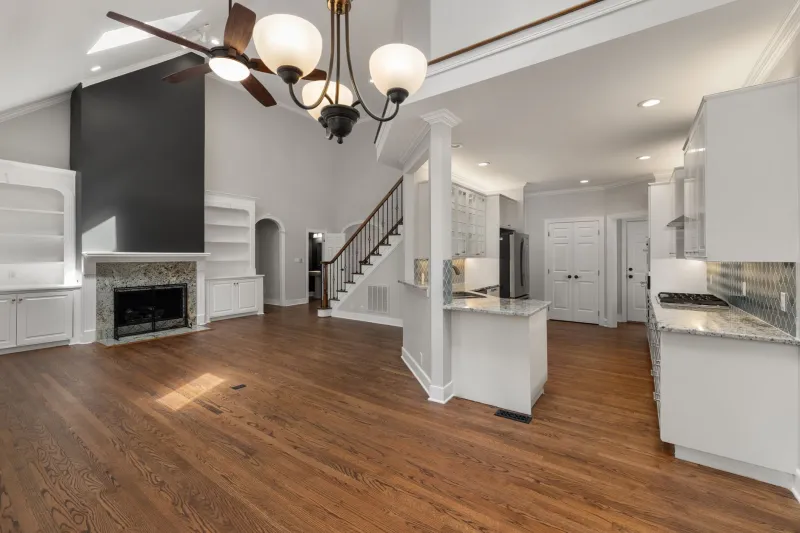
High-gloss floors photograph beautifully. They look sleek, modern, and luxurious in listing photos and design magazine spreads. They also show every footprint, dust particle, pet hair strand, and minor scratch in real life — relentlessly, every single day.
This isn't a matter of cleaning habits. It's physics. High-sheen surfaces reflect light in a way that makes surface variation visible from across the room. Families with kids, pets, or just regular human foot traffic quickly discover that maintaining a high-gloss floor to look like it did on day one is essentially a part-time job.
Five years in, many homeowners with high-gloss floors have either accepted that they'll always look slightly worn, or they're budgeting for a refinish they didn't expect to need this soon.
Matte and satin finishes hide far more of daily life. They're not as dramatic in photos, but they're dramatically easier to live with. If you're choosing a finish, think about what your floors will look like on a random Tuesday morning — not on the day of a dinner party.
Underestimating How a Color Ages
Trends in flooring color move slowly, but they do move. The gray-washed, cool-toned hardwood that dominated design preferences for about a decade is already starting to feel dated in some markets. Homeowners who installed it in 2016 are now living with floors that read as "of their era" in a way they didn't anticipate.
This matters for two reasons. First, if you care about resale value, highly trend-dependent color choices can work against you within a decade. Second — and more practically — floors that start to feel dated affect how you feel about your entire home. You might not be able to explain why the space feels slightly off, but the floors are often the culprit.
Neutral doesn't have to mean boring. Mid-tone, natural-grain hardwoods and warmer-toned luxury vinyl have consistently held up across decades of changing tastes. They're not the flashiest choice, but they're the choice that tends to still look right fifteen years from now.
Picking Durability Based on the Wrong Lifestyle Assumptions
This is one of the most common long-term mistakes we see, and it usually happens because homeowners assess their current lifestyle instead of their likely future lifestyle.
Maybe your kids are small now and mostly contained to certain rooms. In three years, they'll be running through every room with muddy cleats and dragging backpacks across the floor. Maybe you don't have pets right now, but you're thinking about getting a dog. Maybe you work from home and spend far more time walking on your floors than a typical household.
Hard surface floors that look great in low-traffic conditions can show wear quickly under sustained use. Some engineered hardwoods have a wear layer thin enough that refinishing isn't really an option — you get what you get. Some luxury vinyl products that seemed like the durable choice turn out to have surface textures that trap dirt in ways that make them look permanently grimy within a few years.
At Flooring Pelham, we ask lifestyle questions that might feel a little nosy — but they're the reason we can recommend products that will actually hold up for you, not just for the average household.
Skipping the Underlayment Conversation
Underlayment is one of those unglamorous decisions that almost no one thinks about until it's too late. It's the layer between your subfloor and your finished flooring, and it affects sound transmission, thermal comfort, moisture protection, and how your floor feels underfoot.
The wrong underlayment — or skipping it where it's needed — can cause a beautiful floor to feel hollow and cheap underfoot. It can create a clicking or hollow sound with every step that drives you quietly insane over time. In lower-level installations, inadequate moisture barriers in the underlayment can lead to issues that don't surface for a year or two but cause serious damage when they do.
This is a decision that gets made once, during installation, and then lives behind your floors forever. It's worth having an explicit conversation about it rather than just accepting whatever comes standard.
Ignoring How Natural Light Will Change Your Floor Over Time
UV exposure fades floors. This is well understood in theory and almost always underestimated in practice.
Hardwood floors in rooms with significant sun exposure will develop color variation between the areas under rugs or furniture and the exposed areas. This happens gradually — you don't notice it week to week — and then one day you move the couch and there's a distinctly unfaded rectangle on the floor that makes the whole room look patchy.
Some materials are more UV-resistant than others, and some finishes offer better protection. But the most practical defense is also the simplest: use window coverings strategically, rotate rugs occasionally, and choose a floor color that ages gracefully rather than one where the original tone is the whole point.
If you have a sun-drenched living room and you're set on a floor color that depends on a very specific, uniform tone, you're going to be fighting that battle for as long as you live there.
The Long View Is Worth Taking
Every flooring decision involves tradeoffs. There's no perfect material, no perfect finish, no choice that works ideally for every household and every space. But there's a meaningful difference between tradeoffs you made intentionally — knowing what you were signing up for — and tradeoffs you discover five years later when the consequences are already in motion.
That's the real value of working with a team that's going to be honest with you before the sale, not just enthusiastic about it. At Flooring Pelham, we'd rather slow down the selection process to ask harder questions than have you calling us in year four wondering what went wrong.
The floors you'll love longest are almost never the ones that looked most impressive on the first visit. They're the ones someone helped you think all the way through.